
Cyber Essentials for Small Businesses: What Does It Actually Protect You From?
Cyber Essentials reduces common cyber risks through five fundamental controls, but it does not replace backups, monitoring, vulnerability management, penetration testing or incident response.
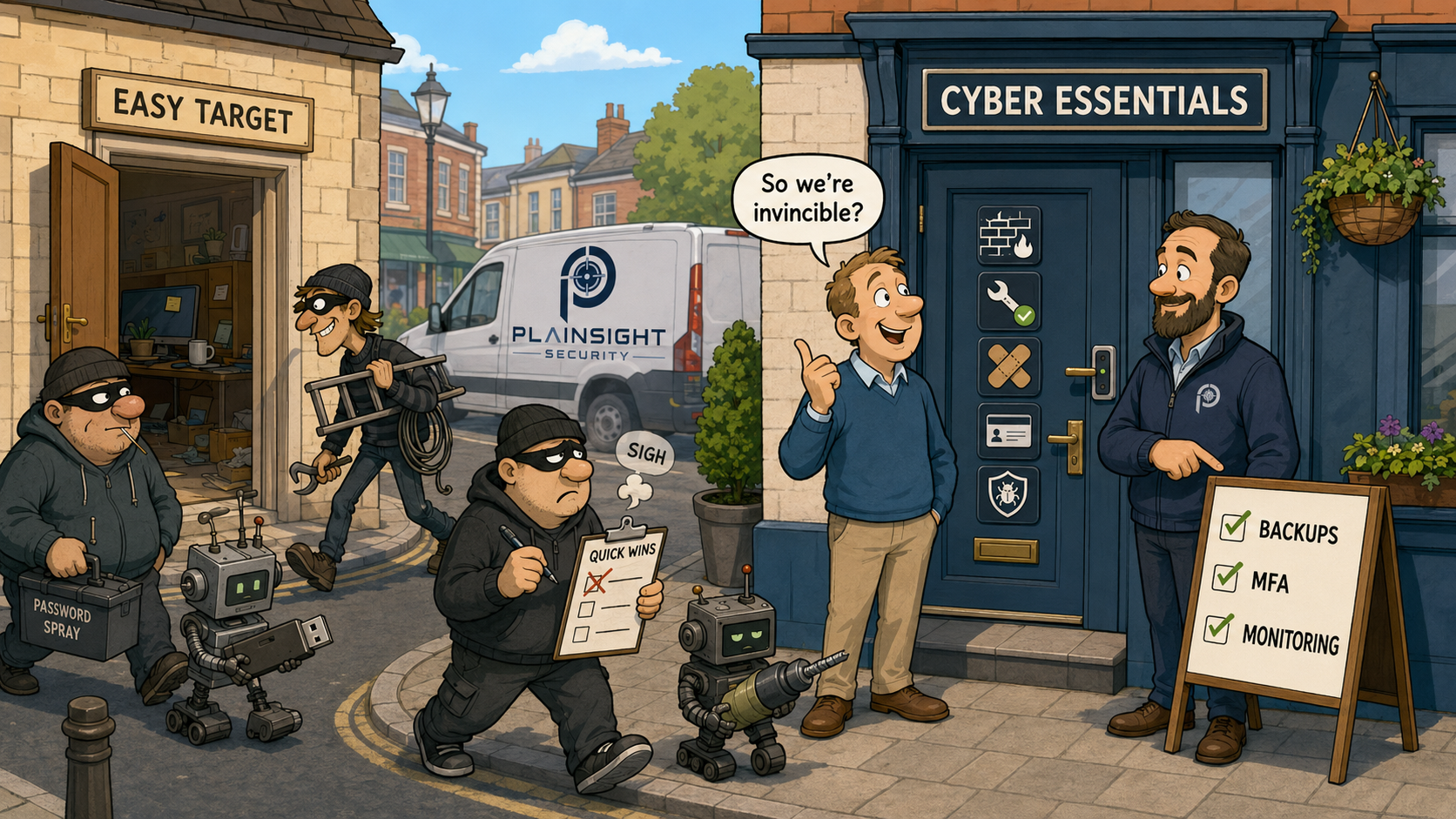
"We've got Cyber Essentials, so are we protected from cyber attacks?"
Not completely.
Cyber Essentials is a baseline of security controls designed to reduce an organisation's exposure to common and preventable cyber threats. It is not a penetration test, a comprehensive vulnerability assessment, or a guarantee that your business cannot be breached.
That distinction is important.
Cyber Essentials is about getting the fundamentals right. It helps remove many of the easy opportunities attackers look for, but it is only one part of a wider cybersecurity strategy.
What does Cyber Essentials actually cover?
Cyber Essentials focuses on five core technical control areas:
- Firewalls
- Secure configuration
- Security update management
- User access control
- Malware protection
For a small business, these controls are less about sophisticated cybersecurity technology and more about preventing common weaknesses from becoming easy entry points.
1. Firewalls
Firewalls control the traffic allowed between networks and devices.
For an SME, this can help prevent unnecessary services from being exposed directly to the internet. If a service does not need to be accessible from outside the organisation, there is generally little reason to expose it.
Reducing externally accessible services reduces the number of opportunities an attacker has to probe.
2. Secure configuration
Systems often come with features and services that a business does not actually need.
Secure configuration is about ensuring that systems are configured appropriately, unnecessary functionality is removed or disabled, and default settings that could introduce unnecessary risk are addressed.
It is essentially about reducing the attack surface.
3. Security update management
Software vulnerabilities are regularly discovered in operating systems, applications, network devices and other technology.
Once a vulnerability has been identified and a security update is available, leaving the affected system unpatched can leave an attacker with a known route into the environment.
Cyber Essentials requires organisations to manage security updates within defined timescales. This helps reduce exposure to vulnerabilities for which fixes are already available.
4. User access control
Not every employee needs access to everything.
Cyber Essentials addresses the principle that users should only have the access they need to perform their role. Administrative privileges should also be restricted.
This matters because a compromised standard user account is considerably less useful to an attacker if it cannot be used to administer systems, install software or access sensitive resources.
5. Malware protection
Malicious software remains a common component of cyber attacks.
Appropriate malware protection can help prevent or detect malicious software running on devices.
However, it is important not to interpret this as "antivirus means we're protected from malware". Modern attacks can involve stolen credentials, legitimate administrative tools, malicious documents, cloud services and other techniques that do not necessarily look like traditional malware.
What does Cyber Essentials protect against?
The easiest way to think about Cyber Essentials is that it reduces the number of easy opportunities available to an attacker.
Opportunistic attacks
Many attacks are not individually planned against a particular small business.
Attackers and automated tools can scan large numbers of systems looking for weaknesses such as exposed services, outdated software and poorly configured devices.
A business with basic security controls properly implemented is less likely to present these easy opportunities.
Exploitation of unpatched software
Attackers frequently exploit known vulnerabilities for which security updates already exist.
Keeping operating systems and applications up to date reduces the window in which these vulnerabilities can be exploited.
This is particularly important because attackers do not necessarily need to discover a new vulnerability. They can simply look for organisations that have not applied an existing fix.
Unnecessary network exposure
An internet-facing service is potentially an entry point.
Firewalls and secure configuration can reduce the number of services that are accessible from outside the organisation.
If a service does not need to be exposed, removing that exposure is generally preferable to relying on it being secure enough to withstand attack.
Compromised accounts
A stolen username and password can give an attacker access to legitimate systems without triggering the same controls as traditional malware.
Appropriate access controls help limit what a compromised account can access.
This is one reason why excessive permissions are dangerous. If every user has administrative access, compromising one account can potentially provide an attacker with considerably more control.
Malware
Endpoint security controls can help prevent or detect malicious software.
This can be particularly valuable against common malware and commodity attacks, although no malware protection is perfect.
Privilege abuse
An attacker who compromises a standard user account may try to escalate their privileges.
Restricting administrative access reduces the opportunities available to them.
The principle is straightforward:
If an account does not need administrator privileges, it should not have them.
Cyber Essentials therefore helps address a number of common weaknesses that can turn an initial compromise into something much more serious.
What Cyber Essentials doesn't protect you from
This is where it is important not to oversell what Cyber Essentials provides.
Cyber Essentials is not designed to comprehensively protect an organisation from every possible cyber attack.
It does not, by itself, provide comprehensive protection against:
- Sophisticated targeted attacks
- Zero-day vulnerabilities
- Complex business logic vulnerabilities
- Advanced social engineering
- Every form of phishing
- Insider threats
- Physical security threats
- Every cloud configuration issue
- Every possible supply-chain attack
Most importantly:
Cyber Essentials does not prove that your systems are free from vulnerabilities.
A system can meet the Cyber Essentials requirements and still contain vulnerabilities.
The purpose of the scheme is to establish a baseline of fundamental security controls, not to demonstrate that an application or infrastructure has been subjected to comprehensive security testing.
That distinction is particularly important when considering vulnerability management and penetration testing.
Cyber Essentials vs Cyber Essentials Plus
Cyber Essentials and Cyber Essentials Plus are related, but they provide different levels of assurance.
| Cyber Essentials | Cyber Essentials Plus |
|---|---|
| Self-assessment | Independent technical assessment |
| Organisation answers questions about its controls | An assessor verifies controls technically |
| Establishes a security baseline | Provides additional independent assurance |
| No hands-on testing of the environment | Includes technical testing |
Cyber Essentials can be a useful starting point for an SME that wants to establish a recognised baseline of cybersecurity controls.
Cyber Essentials Plus goes further by introducing independent technical verification.
For organisations that need greater confidence that their controls have actually been implemented correctly, that additional assurance can be valuable.
What about ransomware?
Ransomware is understandably one of the biggest concerns for small businesses.
Cyber Essentials can help reduce some of the pathways that attackers may use to deploy ransomware.
For example, it addresses areas including:
- Unpatched vulnerabilities
- Excessive privileges
- Poor configuration
- Unnecessary services
- Malware protection
Reducing these weaknesses can make it harder for an attacker to gain an initial foothold or move further through an environment.
But there is an important distinction:
Cyber Essentials isn't a ransomware recovery strategy.
If ransomware successfully encrypts your systems, Cyber Essentials does not restore your data.
A business should also have:
- Reliable backups
- Regular restore testing
- An incident response plan
- Appropriate endpoint detection and protection
- Monitoring of important systems
A backup that has never been tested may not be much use when the business is under pressure to recover.
Cyber Essentials should therefore be viewed as one layer of protection, rather than a substitute for resilience and recovery planning.
What about phishing?
Phishing is another area where expectations need to be realistic.
Cyber Essentials includes controls that can reduce the consequences of a compromised account, but it is not primarily an anti-phishing certification.
A convincing phishing attack can still trick a user into clicking a malicious link, opening a malicious attachment or handing credentials to an attacker.
SMEs should therefore consider additional controls such as:
- Multi-factor authentication (MFA)
- Email security controls
- Security awareness training
- Conditional access
- Password managers
- Phishing-resistant authentication where appropriate
MFA is particularly important because a stolen password is much less useful to an attacker when an additional authentication factor is required.
Cyber Essentials can establish important foundations, but users and authentication remain important parts of the overall security picture.
What about vulnerabilities?
There is an important distinction between managing security updates and having a comprehensive vulnerability management programme.
Cyber Essentials requires organisations to manage security updates. That is an important control, but it does not mean an organisation has comprehensive visibility of every vulnerability in its environment.
Think of it this way:
Cyber Essentials
→ Establishes a baseline of fundamental security controls.
Vulnerability management
→ Provides ongoing visibility of vulnerabilities and helps organisations prioritise remediation.
Penetration testing
→ Investigates whether vulnerabilities can actually be exploited and whether they can be combined into meaningful attack paths.
These activities complement each other.
A vulnerability scanner might identify a potentially vulnerable service. A penetration test can investigate whether that vulnerability is exploitable in the context of the organisation and what an attacker could actually achieve.
For higher-risk systems, relying solely on a baseline certification is unlikely to provide sufficient assurance.
Does Cyber Essentials make a small business a difficult target?
It is useful to think about cybersecurity in terms of attack surface.
Consider two businesses.
One has unsupported software, unnecessary internet-facing services, weak access controls, excessive administrator privileges and poor patching.
The other has properly configured systems, controlled access, supported software, appropriate patching and unnecessary services removed.
Neither business is impossible to attack.
But the first business presents considerably more opportunities to an attacker.
Cyber Essentials helps reduce those opportunities.
That is one of the biggest benefits of the scheme.
Cyber Essentials helps remove many of the easiest opportunities attackers look for.
That is a much more realistic claim than saying that certification makes a business "secure".
What happens after certification?
One of the biggest mistakes an organisation can make is treating Cyber Essentials as a once-a-year exercise.
The business does not stop changing simply because it has achieved certification.
New devices are introduced.
New software is installed.
Employees join and leave.
Administrators change.
Systems stop receiving updates.
Cloud services are added.
Network configurations change.
New vulnerabilities are discovered.
A control that was effective six months ago may no longer be effective today.
Cyber Essentials should therefore be treated as a baseline to maintain, rather than an annual box-ticking exercise.
The real value comes from maintaining those controls throughout the year.
What should an SME do alongside Cyber Essentials?
Cyber Essentials provides a solid foundation, but most businesses will benefit from additional security measures.
At a minimum, SMEs should consider:
- Using MFA wherever possible
- Maintaining reliable, tested backups
- Regularly scanning for vulnerabilities
- Keeping systems and applications patched
- Reviewing administrator access
- Training staff to recognise phishing and social engineering
- Monitoring important systems
- Having an incident response plan
- Considering penetration testing for higher-risk systems
- Considering Cyber Essentials Plus where independent verification provides additional value
The exact level of security required will depend on the business, its technology, the information it holds and the potential impact of a successful attack.
A small business handling highly sensitive information or operating a business-critical internet-facing application may need considerably more assurance than a company with a relatively simple IT environment.
The bottom line
Cyber Essentials is valuable precisely because it focuses on the fundamentals.
It addresses a range of common weaknesses that attackers can exploit, including poor patching, unnecessary network exposure, insecure configurations, excessive privileges and inadequate malware protection.
But it is important to understand what the certification actually means.
Cyber Essentials isn't a guarantee that your business won't be attacked. It's a way of making sure you're not leaving the door open to many of the common attacks that could otherwise be prevented.
For a small business, getting the basics right is important.
Cyber Essentials provides a recognised framework for doing that. Vulnerability management, penetration testing, backups, monitoring, user awareness and incident response can then provide additional layers of protection.
The goal isn't to make your business impossible to attack.
The goal is to make it a much harder and less rewarding target.

Written by
Mark Tomlinson
Our lead penetration tester, Mark Tomlinson, holds The Cyber Scheme Team Leader qualification in infrastructure penetration testing, an advanced certification recognised by the National Cyber Security Centre (NCSC) and used by professionals testing government systems and UK critical national infrastructure. Mark is also registered with the UK Cyber Security Council as a Principal Cyber Security Professional (PriCSP) specialising in Security Testing and holds an MSc in Computer Science with Cyber Security.
More about how we workPut this into practice.
Cyber Essentials, Cyber Essentials Plus, and penetration testing — fixed-price, plain English, and built to stay out of your way.